The writing app that works
in your own voice.

bookmoth is a writing app that learns your voice and keeps your whole story in context to help you plan, draft, and edit, with as much or as little AI as you want.

Get bookmoth $49 $99 See how it works

One-time purchase. No subscription. macOS and Windows.

Launch price of $49 until the solstice, 21 June. Then $99.

bookmoth manuscript editor

“Every AI writing tool I tried produced text that sounded like AI. Competent, clean, utterly lifeless. I built bookmoth because I wanted a writing app that learns how I actually write, stays in my voice, and only helps when I ask it to.”

Stu, founder

Same model. Same prompt.
Completely different prose.

Both written by Claude Opus 4.6. The only difference is that the right one was governed by the writer's own voice profile.

Chapter drafted without a writing profile
Without a writing profile
Click to expand ↗
Chapter drafted with your writing profile
Governed by your writing profile
Click to expand ↗

Four steps to a manuscript
that sounds like you

Brief. Voice. Plan. Draft.

Step 1

Build your brief

A guided conversation draws out your premise, characters, tone, and emotional arc. The richer this is, the better everything downstream becomes.

Step 2

Teach it your voice

Paste in your own prose. bookmoth analyses your sentence rhythms, dialogue patterns, and vocabulary at the mechanical level, then compiles it into a writing profile that governs every draft. Not just English: it works across major European and Asian languages too.

Step 3

Structure your story, scene by scene

Every chapter breaks down into scenes, each with its own goal, conflict, and turn. Generate a plan from your brief, paste in an outline you've already written, or import an existing manuscript. Change the plan and the manuscript follows. Change the manuscript and the plan stays in sync.

Step 4

Draft, revise, keep everything

When you want a draft, each scene is written with full awareness of what came before and what comes next. Polish a single scene, run another pass on a chapter, or start a fresh version without losing anything. Choose your model: Anthropic, OpenRouter, or a local LLM.

The codex

A codex that builds itself

Most tools make you build the codex by hand. bookmoth builds it for you.

Worldbuilding

It populates itself, with your approval

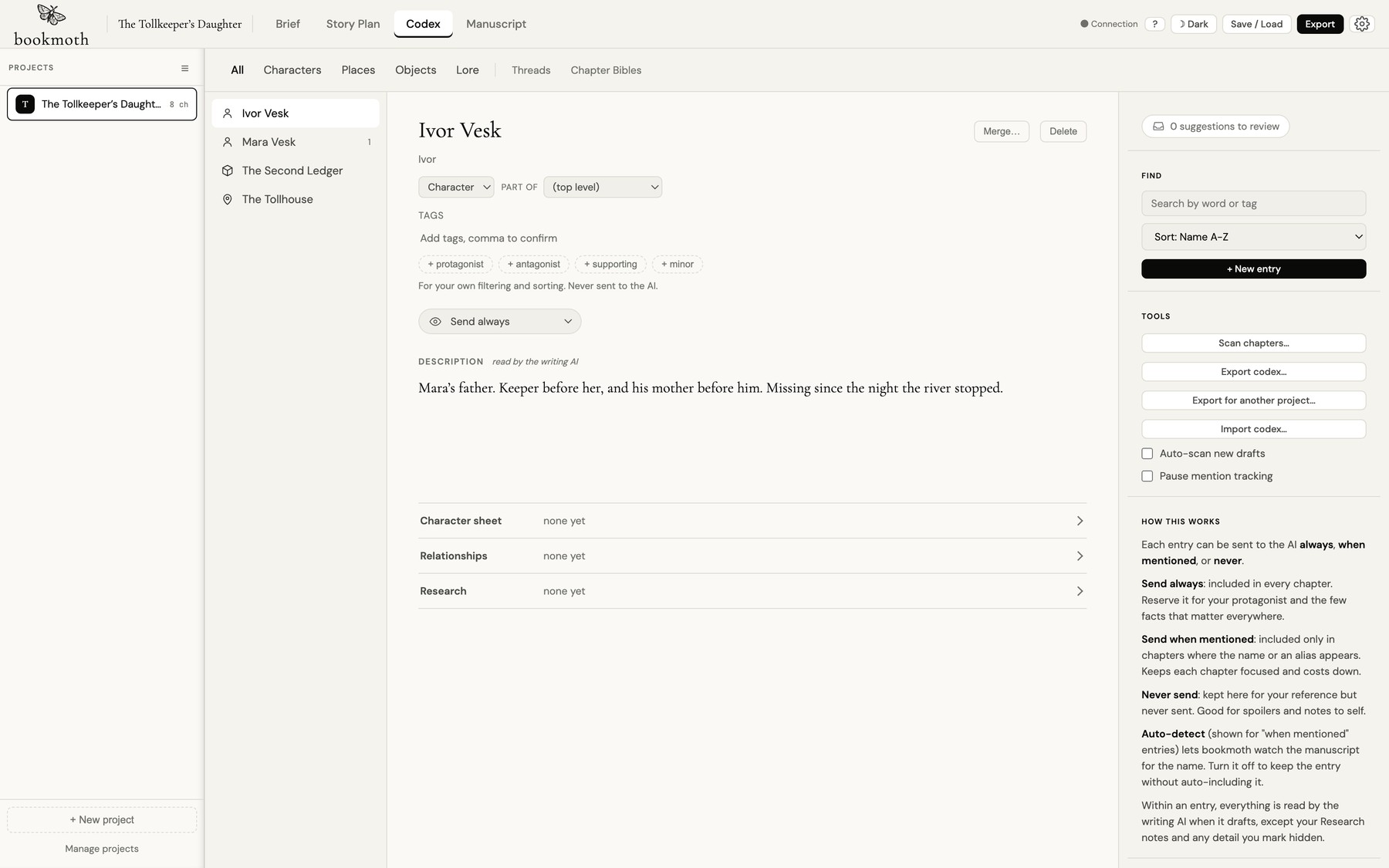
As you draft and import, bookmoth scans your chapters, proposes new characters, places and lore, and flags contradictions before they become canon. Nothing is saved until you accept it, and you decide what the AI sees, per entry and even per detail.

bookmoth codex review queue proposing new entries scanned from drafted chapters
Voice, per character

Every character in their own voice

Give a character a handful of example lines and bookmoth writes their dialogue in that voice, the same way it writes your book in yours. Aliases keep one person together however you name them, and relationships hold your world consistent.

A bookmoth codex character entry with a Voice field of example dialogue lines

The editor

An editor that has read your chapter

A conversation inside your manuscript, always reading your live prose.

In the manuscript

Talk it through, edit in place

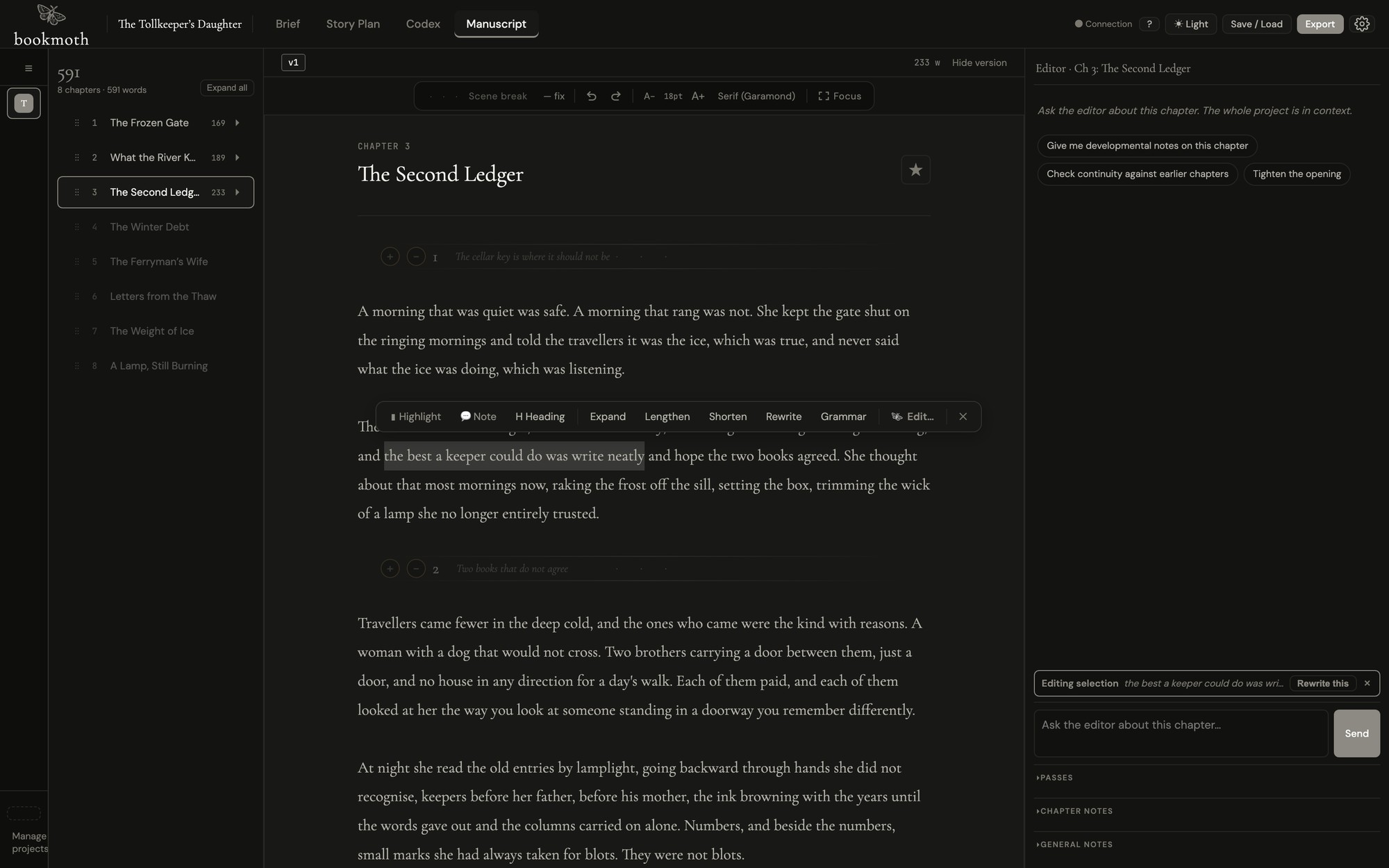
Highlight a sentence and say what you want, and the editor proposes a change to just that selection, shown as a diff you accept or dismiss. Ask for a structural read and it answers like a colleague who already knows your book. It can even reshape your chapter cards and scenes through the conversation.

The bookmoth manuscript page with a highlighted passage and the editor chat open alongside

Edit by conversation

Tighten a passage, raise the tension, or check continuity, all in plain language with the whole book in context.

Highlight to edit

Select a passage, describe the change, and it lands only there, shown as a reviewable diff.

Nothing written silently

Every change goes through a diff you review and saves as a version you can roll back.

Themes

Make the room your own

Three colourways, each with a light and a dark, and a live picker that reskins the whole app as you flip between them. bookmoth, Paradice, and Mithril.

The bookmoth theme picker switching between the bookmoth, Paradice and Mithril colourways in light and dark

Curious what bookmoth
sees in your writing?

Paste a few paragraphs. Get a free voice portrait by email. No account needed, no strings. Just an honest editorial read of your prose. Works in most major languages.

Get your voice portrait

See it work

From first conversation to first chapter

Write without distraction

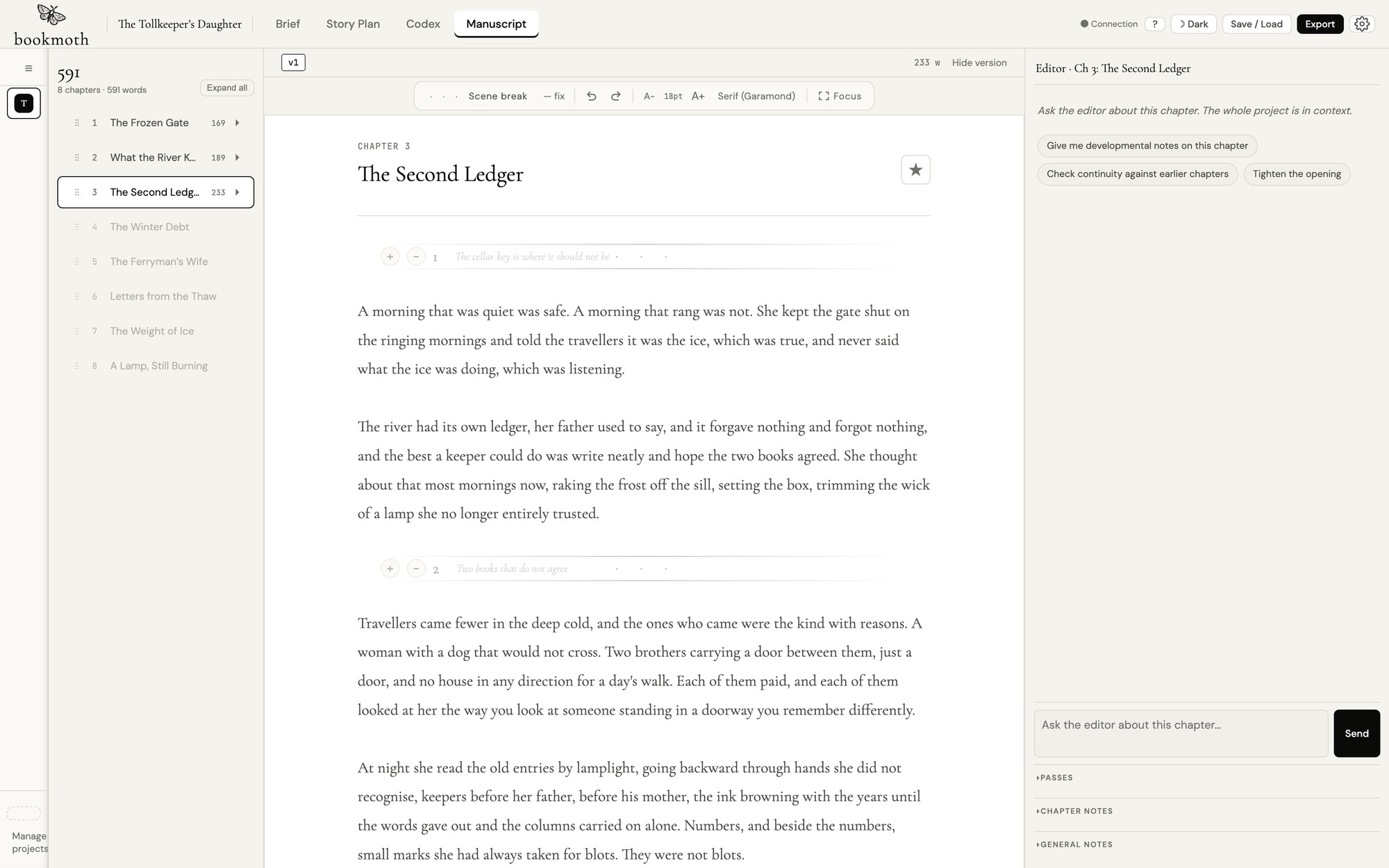
Focus mode light Focus mode dark

Editorial feedback

Ask the Editor reads your chapter in the context of your entire manuscript, your brief, and your voice profile. Structural, tonal, and craft-level notes.

Version history

Every chapter carries its own versions. Draft, revise, start fresh. Your earlier work is always there. Nothing is overwritten, nothing is lost.

Everything local

No account. No cloud. No analytics. Your manuscript, your brief, your writing profile: all stored on your machine.

Simple pricing

One fee. No subscription. Ever.

Launch price of $49 until the solstice, 21 June. Then $99.

bookmoth
$49 $99
launch price, ends 21 June
  • Full app for macOS and Windows
  • Free updates forever
  • Voice profile from your own prose
  • Self-building codex with character voices
  • Scene-by-scene drafting with version history
  • Document-aware editor you can talk to
  • Paste your own outline or generate one
  • Import your existing manuscript
  • Everything stays on your own computer
Get bookmoth

Bring your own API key (Anthropic or OpenRouter). A chapter costs anywhere from 2 to 30 cents depending on your model. You control your spend.

How the costs work

You buy bookmoth once. Updates are free, forever. No tiers, no usage caps.

AI costs are between you and your API provider. A chapter costs anywhere from 2 to 30 cents depending on the model: Claude sits at the top end for maximum quality, OpenRouter models bring it down to a few cents, and local models are free. You see exactly what you spend in your own dashboard.

Most AI writing subscriptions charge $19-29/month. In three months you've spent more than bookmoth costs forever.

Questions

Does it actually write in my voice?
This is the entire point. bookmoth analyses your prose at the sentence level and builds a writing profile from your actual patterns: your rhythms, your dialogue instincts, where you're lyrical and where you're blunt. That profile sits at the core of every chapter draft. The output won't be indistinguishable from what you'd write by hand, but it will be recognisably in your voice rather than the generic literary register most AI tools reach for by default.
What is the codex?
The codex is bookmoth's built-in reference for your world: characters, places, lore and items, with aliases, per-character voices, and relationships. It builds itself as you draft, scanning your chapters, proposing entries for your approval, and flagging contradictions before they become canon. You control exactly what the AI sees, per entry and even per detail.
What can the editor do?
The editor is a conversation that lives inside your manuscript and reads your live prose, your brief, your voice profile, the plan, and the codex entries that matter. Ask it to tighten a passage, raise the tension, or check continuity, highlight a sentence and have it edit just that selection, or have it reshape your chapter cards and scenes. Nothing reaches your manuscript without you approving a diff, and every change saves as a version you can roll back.
What do I need to get started?
A Mac (macOS 10.15+) or Windows PC, and an Anthropic API key from console.anthropic.com. Takes two minutes to set up. No account, no subscription, no cloud storage.
How much does the AI cost to run?
Anywhere from 2 to 30 cents per chapter depending on the model you choose. Claude sits at the top end, OpenRouter models can bring it down to a few cents, and local models cost nothing. You control your spend through your own API dashboard.
Is the $49 price changing?
$49 is the launch price. On 21 June, the summer solstice, it goes to $99, still a one-time purchase with no subscription. Buy before then to lock in $49, and you keep every future update free, including everything in 2.1 and whatever comes after.
Will it write my whole book for me?
It drafts scene by scene from your brief, your voice profile, and your plan. Each scene is aware of what came before it. You steer the creative direction, edit individual scenes or whole chapters, run another pass, or start a new version. Think of it as a collaborator who sounds like you, not an autopilot.
Can I bring in an existing manuscript?
Yes. Import a .docx or .txt file with chapter markers, or paste in an existing outline and bookmoth will structure it into scenes for you. Either way, the editor picks up where you left off. Your existing work becomes the foundation.
Is my work private?
Completely. Everything is stored locally on your machine. No bookmoth account, no cloud, no analytics, no telemetry. Your prose is only ever sent to the AI provider you choose, under your own API key. bookmoth itself never sees your work, never stores it, and never trains on it. The voice profile is built and used on your machine.
Do you train AI on my writing?
No. Never. bookmoth doesn't have a model of its own. Your prose goes to the AI provider you choose (Anthropic, OpenRouter, or a local LLM via Ollama or LM Studio), via your own API key. Anthropic doesn't train on API traffic by default. Local models train on nothing. Your work stays yours.
How is this different from Sudowrite?
Sudowrite treats AI as a co-writer with style options like "formal" or "casual." bookmoth reverse-engineers your actual voice from your own prose and enforces it structurally on every sentence. It's also a one-time $49 purchase, not a monthly subscription.
How does it compare to NovelCrafter?
NovelCrafter is strong on planning and structure. bookmoth goes deeper on the AI drafting side. The voice profile system, where the app analyses your prose and constrains every chapter to match your patterns, is something NovelCrafter does not do.
Can I use it for non-fiction?
Absolutely. Memoirs, narrative non-fiction, guidebooks, any long-form prose project. The voice system works the same way regardless of genre.
Can I write mature or explicit content?
Yes. bookmoth itself doesn't filter anything. How explicit the output actually is depends on the model you send it to. Claude (the default) will soften explicit scenes, that's Anthropic's product rather than ours. Uncensored models on OpenRouter, or local models via Ollama and LM Studio, will render whatever your brief calls for. Advanced Routing lets you mix: Claude for editorial feedback and light tasks, an uncensored model for the scenes that need it.
Does it work in languages other than English?
It does. The prose mechanics bookmoth analyses (sentence rhythm, repetition, specificity, interiority) work across languages. We've tested with Spanish, French, German, and Portuguese. The voice portrait and the app itself respond in the language you write in. If you try it in a language we haven't tested yet, we'd love to hear how it goes.
Windows?
Available in early access. Windows will show a SmartScreen prompt the first time you run it. This is normal for independently distributed software. Click More info, then Run anyway.
From the journal

Essays on writing, voice,
and finishing the book you started.

How to find your writing voice
Essay · April 24, 2026 · 9 min read

How to find your writing voice (without faking it)

Voice is the most talked-about thing in writing advice and the least well defined. A practical guide for writers who are tired of the clichés.

Read the essay →
See all essays

Write your book,
in your own voice.

$49. Once. No subscription. Free updates forever.

Get bookmoth $49 $99