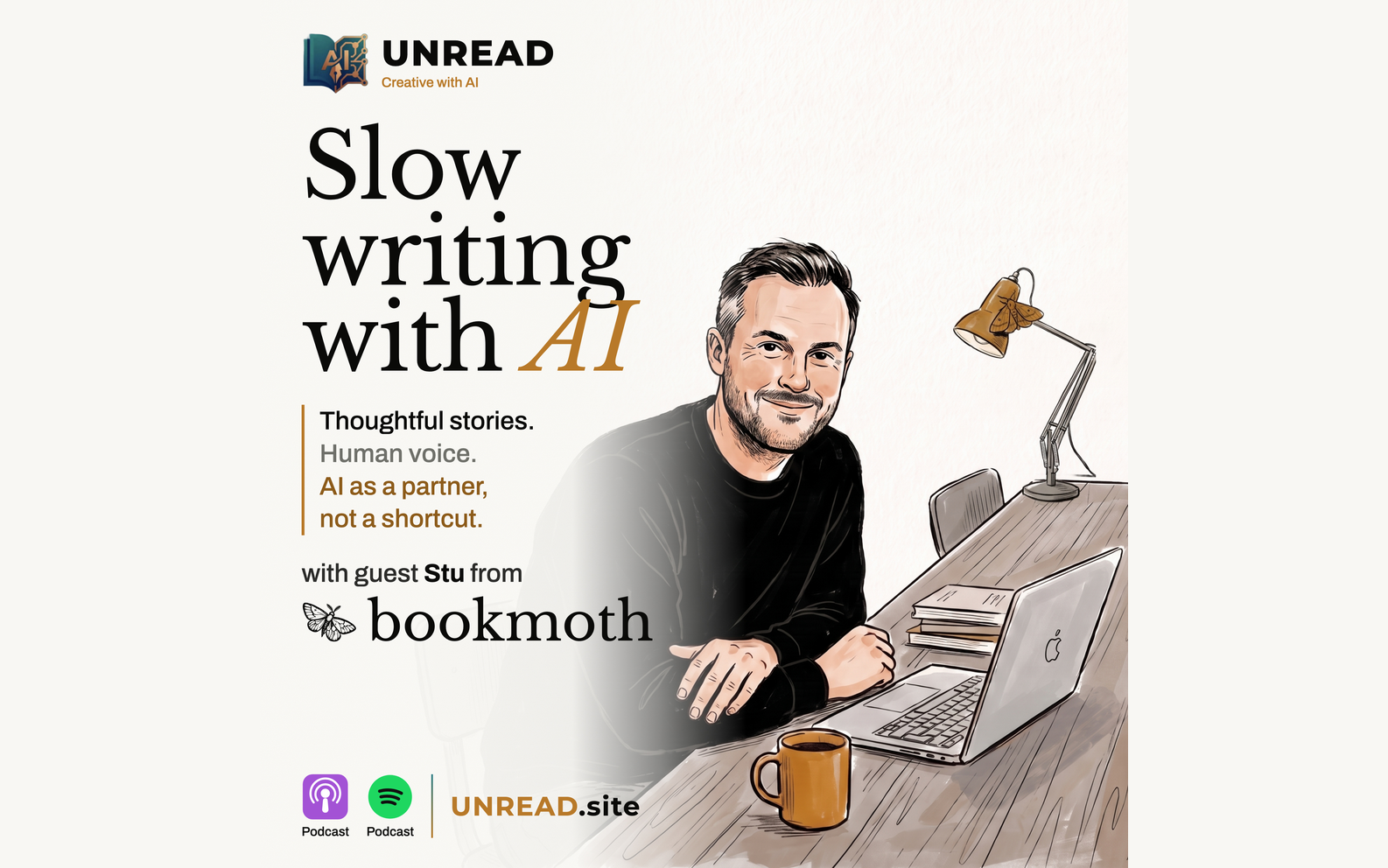
Joerg Fritsch makes a podcast called Unread, about AI in art, philosophy and the future of storytelling. He asked me on to talk about bookmoth. We spent about half an hour on it, and most of that half hour turned out to be about something else.
32 minutes. Also on Apple Podcasts.
Here is the part I keep coming back to.
Nearly every argument for AI in writing is an argument about speed
A novel in a weekend. Ten thousand words before lunch. Twelve books a year instead of one. Whatever the tool, the promise underneath it is the same: you will get to the end sooner.
I understand the appeal. I don’t think it’s what most writers actually want. The people who write to me are not trying to produce more books. They are trying to finish the one they have, and to still recognise it when they do.
Speed sells because it’s easy to measure. What it costs you isn’t.
What you lose when you go fast is the sitting there. The afternoon spent working out whether a chapter earns its place. The realisation on a walk that it should be the sister who lies. None of that is typing, none of it shows up in a word count, and it is where the book actually gets made. Hand that part to a machine and you haven’t saved time, you’ve skipped the work.
So bookmoth isn’t built to make you faster. It’s built to clear away the parts that aren’t thinking: holding continuity, remembering what you decided nine chapters ago, catching the drift out of your own voice. Take those off the desk and the thinking has room. Some people do finish sooner. That’s a side effect, not the pitch.
Authorship is judgment, not typing
Joerg pushed on the obvious question. If a model produced some of the sentences, whose book is it?
Authorship was never about who moved the fingers. It’s about who made the judgments. Which scene earns its place. Which line is a lie. Which character is being let off too easily. What the book is actually about, which is almost never what you thought when you started.
A model can produce sentences all day. It can’t make those calls, because it has no stake in the outcome and no taste to offend. Every one of them is yours. Stop making them and the book stops being yours, whether or not you typed it.
Which is also why did you use AI isn’t a very useful question on its own. A writer who directs closely, throws out most of what comes back and rewrites the rest has authored the thing. A writer who takes the first draft hasn’t, and it shows, because nobody made the decisions.
Where the name came from
Joerg asked about the name, which I was pleased about, because nobody asks.
The short answer is that I wanted it to sound like a bookshop rather than a startup. Nearly everything in this category is named like software. I wanted something that could sit on a spine. The longer answer is in the episode.
Your book stays on your machine
One more thing came up that matters more than it sounds.
bookmoth keeps your manuscript in files on your own computer. There is no bookmoth server holding your novel. You bring your own API key, so the only thing that ever leaves your machine is the specific request you asked for, sent to the model provider you picked.
That’s partly a privacy position and partly a longevity one. Writers work on a book for years. Software companies don’t always last that long. Your manuscript shouldn’t live somewhere that can be switched off.
Joerg is a good interviewer, in the specific sense that he asked me things I had no prepared answer for. The whole conversation is up there if you want the rest of it.
Related: why your first draft doesn’t sound like you, and which AI writing tools actually preserve your voice.